

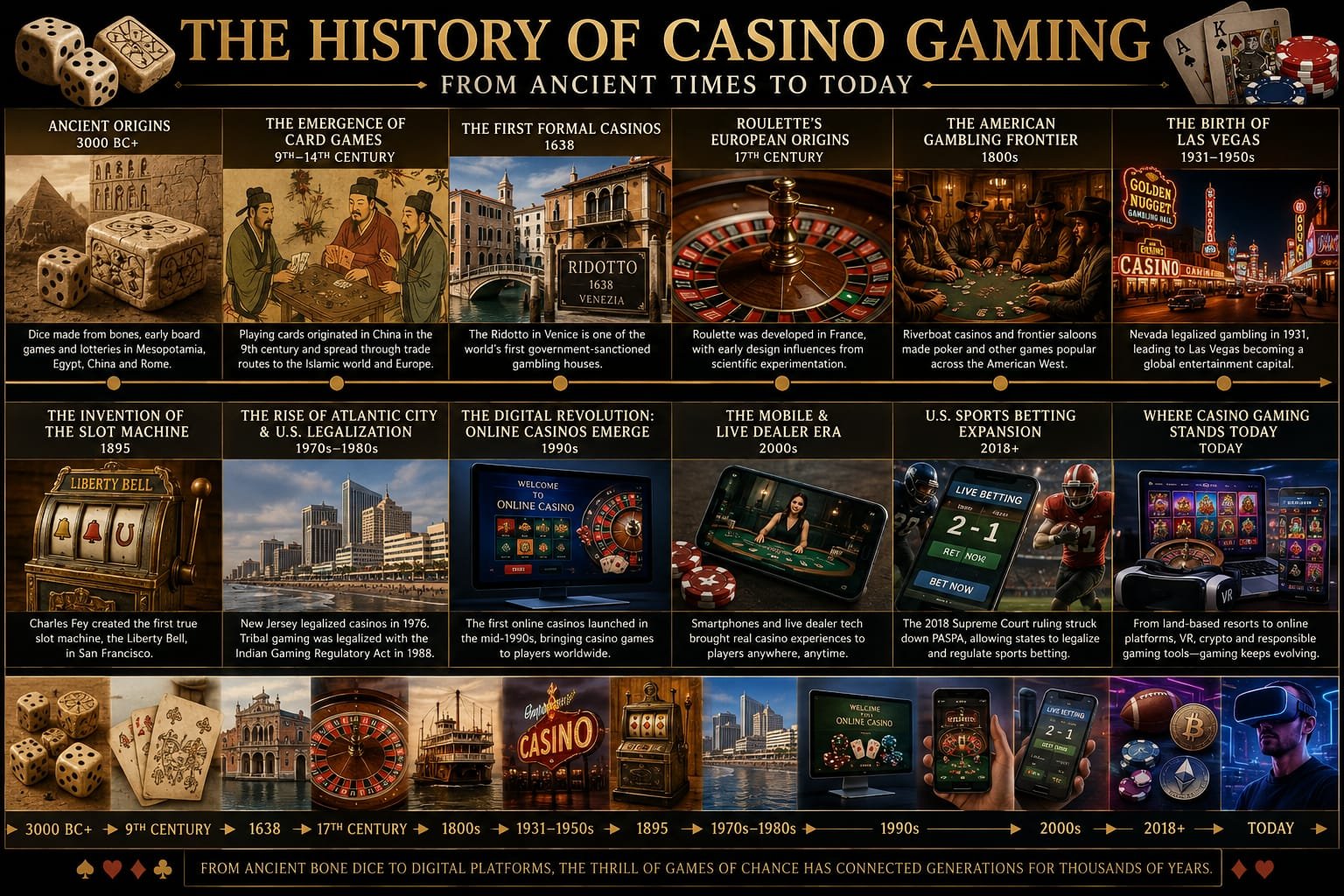
Gambling in some form has existed for nearly as long as recorded human history, evolving from simple dice games played with carved bones to the sophisticated, technology-driven online casinos of today. Understanding this history offers a genuinely fascinating perspective on how deeply gambling is woven into human culture, and how dramatically the experience has transformed across centuries. This guide traces that journey from ancient origins to the present day.
Ancient Origins: Dice, Bones, and Early Games of Chance
Archaeological evidence suggests that gambling-like activities date back thousands of years across numerous ancient civilizations. In ancient Mesopotamia, dice carved from animal bones (a precursor to modern dice, sometimes called “astragali”) have been found in archaeological sites dating back over 5,000 years, believed to have been used both for religious divination and gaming purposes.
Ancient Egyptian sites have revealed evidence of board games with gambling elements, and ancient Chinese civilization is credited with developing some of the earliest documented card games and even a rudimentary form of lottery, believed to have been used to help fund state projects, including, according to some historical accounts, elements of the Great Wall.
Ancient Rome had a notably complex relationship with gambling — while it was technically illegal for most of Roman history except during specific festivals, it remained widely practiced regardless, with dice games (played with the same astragali-style bones) being particularly popular among all social classes, including emperors.
The Emergence of Card Games
Playing cards are generally believed to have originated in 9th-century China, eventually spreading along trade routes through the Islamic world and into Europe by the late 14th century. European card games evolved considerably over subsequent centuries, eventually giving rise to games that would become direct ancestors of modern casino staples like poker and blackjack.
The First Formal Casinos
The word “casino” itself derives from Italian, originally referring to a small country villa or social club used for various forms of entertainment, including gambling. The Ridotto, established in Venice in 1638, is widely credited as one of the first government-sanctioned, dedicated gambling houses in the world — created specifically to provide a controlled, regulated environment for gambling during the city’s famous Carnival season, rather than leaving the activity to unregulated, informal settings.
This model of formal, licensed gambling establishments gradually spread across Europe throughout the 18th and 19th centuries, with notable casinos emerging in destinations like Baden-Baden in Germany and, most famously, Monte Carlo in Monaco, established in 1863, which became a glamorous destination for European aristocracy and remains one of the most iconic casino locations in the world today.
Roulette’s European Origins
Roulette, often considered the quintessential casino game, is generally credited to 17th-century France, with some historical accounts crediting mathematician and physicist Blaise Pascal with early design elements, developed originally as part of unrelated scientific experimentation with perpetual motion devices. The game evolved over subsequent decades into the version recognizable today, with the American double-zero variant emerging later as the game crossed the Atlantic and was adapted for the growing American gambling market.
The American Gambling Frontier
Gambling took on a distinctly different character as it developed in the United States, particularly during the westward expansion of the 19th century. Riverboat casinos along the Mississippi River became notorious gathering places for card games, particularly poker, which developed much of its modern American identity during this era. Saloons throughout frontier towns commonly featured various card and dice games, often played in a considerably less formal, less regulated environment than the aristocratic European casino model.
The Birth of Las Vegas
Nevada legalized gambling in 1931, largely as a response to Depression-era economic struggles, laying the groundwork for what would eventually become the most famous gambling destination in the world. Las Vegas’s transformation from a small desert railroad town into a global gambling and entertainment capital accelerated significantly in the following decades, with the construction of increasingly elaborate casino resorts throughout the mid-20th century, often financed through a complex mix of legitimate business investment and, particularly in the earlier decades, organized crime involvement, which was gradually pushed out through increased regulatory scrutiny from the 1970s onward.
The Invention of the Slot Machine
Charles Fey, a mechanic based in San Francisco, is widely credited with inventing the first true slot machine in 1895 — the Liberty Bell, featuring three spinning reels and a handful of symbols including horseshoes, playing card suits, and, of course, the bell that gave the machine its name. This mechanical invention laid the foundation for what would eventually become the single most popular and profitable category of casino games worldwide, evolving through electromechanical designs in the mid-20th century and eventually into the fully digital, RNG-powered video slots dominant today.
The Rise of Atlantic City and Expanding US Legalization
New Jersey legalized casino gambling in Atlantic City in 1976, creating the first major legal gambling destination on the US East Coast and breaking Nevada’s decades-long monopoly on legal American casino gaming. This began a gradual, ongoing trend of expanding legalization across various US states over subsequent decades, including the growth of tribal gaming following the Indian Gaming Regulatory Act of 1988, which established a legal framework for Native American tribes to operate casino gaming on tribal lands.
The Digital Revolution: Online Casinos Emerge
The mid-1990s marked the beginning of the online casino era, with early platforms emerging shortly after the broader commercialization of the internet. Antigua and Barbuda passed early legislation enabling online gambling licensing in 1994, and the first fully functional online casinos began appearing shortly after, offering simplified digital versions of classic casino games to a rapidly growing online audience.
The UK became an early leader in formal online gambling regulation, with the establishment of the UK Gambling Commission (building on earlier gambling legislation) providing a robust regulatory framework that has since become a global benchmark for player protection standards in online gaming.
The Mobile and Live Dealer Era
The proliferation of smartphones from the late 2000s onward fundamentally transformed how people access online casino gaming, shifting a substantial portion of play from desktop computers to mobile devices, accessible virtually anywhere. This period also saw the emergence of live dealer technology, blending real-time video streaming with genuine physical game elements, addressing earlier criticisms that online casinos lacked the authenticity and atmosphere of physical gambling venues.
US Sports Betting Expansion
A landmark 2018 US Supreme Court decision struck down the federal Professional and Amateur Sports Protection Act (PASPA), which had previously restricted legal sports betting to Nevada in most cases. This ruling opened the door for individual US states to legalize and regulate sports betting independently, leading to a rapid, ongoing expansion of legal sports betting markets across numerous states in the years since.
Where Casino Gaming Stands Today
Modern casino gaming spans an enormous spectrum — from traditional physical casino resorts in destinations like Las Vegas, Macau, and Monte Carlo, to sophisticated online platforms offering thousands of digital slot titles, live dealer tables, and mobile sports betting, all accessible from a smartphone. The industry continues to evolve, with ongoing developments in areas like virtual reality gaming, cryptocurrency payment integration, and increasingly sophisticated responsible gambling technology designed to help players maintain healthy boundaries around their play.
Final Thoughts
The history of casino gaming reflects a genuinely fascinating thread running through human civilization — from ancient bone dice used in religious ceremonies, to opulent European gambling houses catering to aristocracy, to the neon-lit resorts of Las Vegas, and now to the sophisticated, heavily regulated digital platforms of today. Understanding this evolution offers valuable context for appreciating just how deeply embedded games of chance are in human culture, and how dramatically technology and regulation have reshaped the experience across just the past few decades alone.