

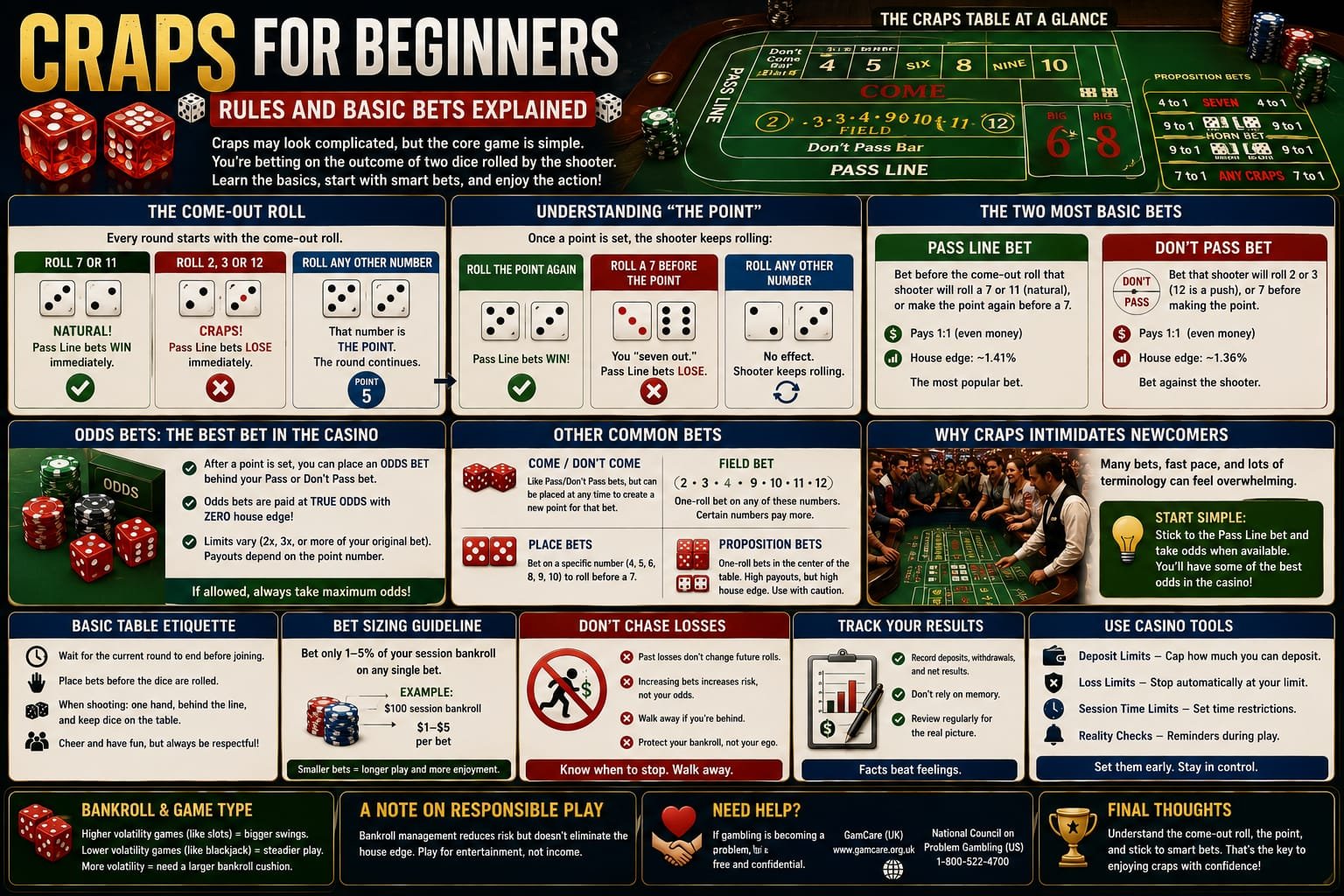
Craps has a reputation as one of the most intimidating games on the casino floor — a crowded table, a dizzying betting layout, and a dealer calling out terminology that sounds like a different language entirely. But strip away the intimidation factor, and craps is actually built on a fairly simple core concept, with plenty of room to start small and expand your understanding over time. This guide breaks down the essentials for genuine beginners.
The Basic Concept
Craps is a dice game played with two standard six-sided dice, where players bet on the outcome of dice rolls made by a player known as the “shooter” (which rotates around the table, meaning any player can take a turn rolling). While the betting layout can look overwhelming, the underlying game follows a straightforward structure once you understand the concept of the “come-out roll” and the “point.”
The Come-Out Roll
Every round of craps begins with a “come-out roll” — the shooter’s first roll in a new round. This roll determines the immediate outcome for certain bets, or establishes what’s called “the point” for the rest of the round:
- If the come-out roll is 7 or 11: This is called a “natural,” and Pass Line bets win immediately
- If the come-out roll is 2, 3, or 12: This is called “craps,” and Pass Line bets lose immediately
- If the come-out roll is any other number (4, 5, 6, 8, 9, or 10): This number becomes “the point,” and the round continues
Understanding “The Point”
Once a point is established, the shooter continues rolling the dice, with the specific goal now being to roll that same point number again before rolling a 7. If the shooter rolls the point number again, Pass Line bets win. If the shooter rolls a 7 before rolling the point again, Pass Line bets lose, and the round ends (this is often called “sevening out”). Any other number rolled during this phase simply has no direct effect on the basic Pass Line bet, and the shooter continues rolling until either the point or a 7 comes up.
The Two Most Basic Bets
Pass Line Bet
This is the most fundamental and popular bet in craps, made before the come-out roll. You’re essentially betting that the shooter will either roll a natural (7 or 11) on the come-out roll, or successfully roll their established point again before rolling a 7. Pass Line bets pay even money (1:1) and carry a house edge of approximately 1.41%, among the better odds available in the casino.
Don’t Pass Bet
The opposite of the Pass Line bet, this wagers that the shooter will either roll craps (2 or 3, with 12 typically being a push rather than a win for this bet) on the come-out roll, or fail to roll their point again before rolling a 7. This bet carries a slightly better house edge for the player, at approximately 1.36%, though it’s less popular since betting against the shooter can feel socially awkward at a lively, shooter-supportive table.
Odds Bets: The Best Bet in the Casino
Once a point is established, most craps tables allow players to place an additional “odds bet” behind their original Pass Line or Don’t Pass bet. This is genuinely one of the best bets available anywhere in a casino, because odds bets are paid at true mathematical odds, with zero house edge — the casino makes no profit margin on this specific additional wager. The odds bet size is typically limited to a multiple of your original bet (such as 2x, 3x, or sometimes much higher, depending on the specific casino’s rules), and payouts vary depending on the specific point number, since some numbers are statistically less likely to be rolled again before a 7 than others.
Because of this genuinely favorable structure, experienced craps players typically maximize their allowed odds bet whenever possible, since it’s essentially “free” from a house edge perspective, unlike every other bet on the table.
Other Common Craps Bets
Come Bet / Don’t Come Bet: Function similarly to Pass Line and Don’t Pass bets, but can be placed at any point during a round rather than only before the come-out roll, effectively creating a new independent “point” for that specific bet.
Field Bet: A single-roll bet on whether the next roll will be one of several specific numbers (typically 2, 3, 4, 9, 10, 11, or 12), with certain numbers sometimes paying enhanced odds. This bet is settled after just one roll, rather than continuing across multiple rolls like Pass Line bets.
Place Bets: Allow you to bet directly on a specific number (4, 5, 6, 8, 9, or 10) being rolled before a 7, without needing to wait for that number to become the established point first.
Proposition Bets: A collection of single-roll bets in the center of the table, covering specific outcomes like rolling a particular number exactly, or rolling any craps number. These carry significantly higher house edges than Pass Line, Don’t Pass, or odds bets, and are generally considered poor value from a purely mathematical standpoint, despite their appealing higher payout odds.
Why Craps Intimidates Newcomers (and Why It Shouldn’t)
Much of craps’ intimidating reputation comes from the sheer number of possible bets displayed on the table layout, combined with the fast pace and enthusiastic energy typical at a lively craps table. In reality, a beginner can comfortably play craps by focusing exclusively on the Pass Line bet (plus taking odds once a point is established), completely ignoring the dozens of other proposition and specialty bets available on the table. This simplified approach gives you access to some of the best odds in the entire casino without needing to understand every corner of the betting layout.
Basic Craps Table Etiquette
- Wait for the current round to conclude before joining a table mid-round if you’re unfamiliar with the current point situation
- Place bets before the dice are rolled, since betting after the shooter has already thrown is not permitted
- Handle dice with one hand when it’s your turn to shoot, and avoid letting dice leave the table surface
- Cheer respectfully — craps tables are known for their energetic, social atmosphere, and good sportsmanship (whether the table is winning or losing collectively) is part of the tradition
A Note on Responsible Play
Craps’ energetic pace and social atmosphere can make it easy to get caught up in the excitement of a hot table, potentially leading to larger or more frequent bets than originally intended. Setting a clear bankroll and sticking primarily to the better-odds bets (Pass Line, Don’t Pass, and odds bets) rather than the higher house-edge proposition bets is both a mathematically sound and financially prudent approach. As with any casino game, treat craps as entertainment, set firm limits before you begin, and use available responsible gambling tools if you find it difficult to stay within your intended budget.
Final Thoughts
Craps’ reputation for complexity is largely a matter of table layout rather than genuine rule complexity — the core mechanics of the come-out roll and the point are straightforward once explained clearly, and a beginner can comfortably enjoy the game’s energetic atmosphere while sticking to just the Pass Line bet and its associated odds bet, which together offer some of the best statistical value available anywhere on the casino floor.