
Casino gambling has accumulated more myths, superstitions, and misunderstandings than almost any other form of entertainment — passed between players, reinforced by movies, and sometimes even repeated by casino staff who should know better. Separating fact from fiction can genuinely improve how you approach casino games, helping you make decisions based on actual math rather than folklore. Here are the most persistent myths, thoroughly debunked.
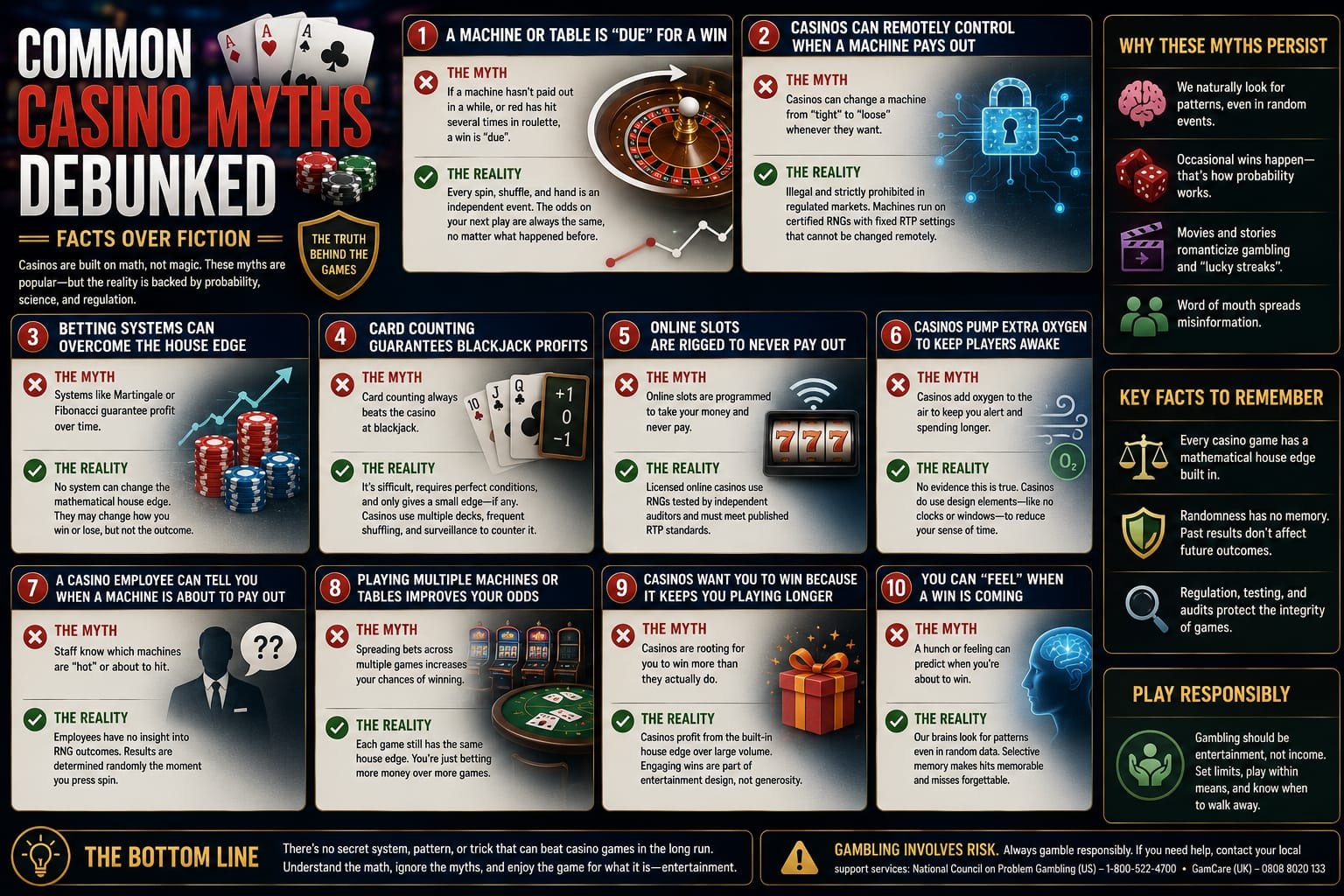
Myth 1: A Machine or Table Is “Due” for a Win
This is perhaps the most widespread gambling myth of all, often called the “gambler’s fallacy.” The belief goes something like this: if a slot machine hasn’t paid out in a while, or if roulette has landed on red several times in a row, the next outcome is somehow more likely to break the pattern.
The reality: Every spin of a certified slot machine, every spin of a roulette wheel, and every shuffle of cards in most games is a statistically independent event. The random number generator or the physical randomness of a wheel has no memory of previous outcomes. The odds on your next spin or hand are exactly the same regardless of what happened before — a machine that hasn’t paid out in hours has identical odds to one that just hit a jackpot.
Myth 2: Casinos Can Remotely Control When a Machine Pays Out
Some players believe casinos can flip a switch to make a specific machine “tighter” or “looser” at will, perhaps to encourage more spending during slow periods or reward loyal players during busy ones.
The reality: In regulated markets, this would violate licensing requirements and is actively monitored against through independent auditing and certification of game software. Slot machines operate according to their programmed RNG parameters and certified RTP settings, not real-time manual manipulation. Casinos do choose which specific games (with their pre-set RTP configurations) to offer, but they can’t dynamically alter a certified machine’s odds during operation without violating regulatory requirements.
Myth 3: Betting Systems Can Overcome the House Edge
From the Martingale system in roulette to various “proven” blackjack betting progressions, countless systems claim to guarantee profit through clever bet sizing and timing.
The reality: No betting system changes the underlying mathematical house edge built into a casino game. Betting systems can change the pattern and distribution of how you win or lose money — for example, more frequent small wins punctuated by occasional large losses, or vice versa — but they cannot alter the fundamental statistical disadvantage inherent in the game itself. This is a mathematical certainty, not a matter of opinion or system sophistication.
Myth 4: Card Counting Guarantees Blackjack Profits
Popularized by movies and the famous MIT Blackjack Team, card counting has developed a reputation as a surefire way to beat the casino at blackjack.
The reality: While card counting is a legitimate mathematical technique that can theoretically shift the odds slightly in a skilled player’s favor under specific conditions, it requires extensive practice, discipline, and specific table conditions (like single or double-deck games, which have become increasingly rare) to be effective. Modern casinos use multiple-deck shoes, frequent shuffling, and sophisticated surveillance specifically designed to counter card counting. Additionally, even with a genuine edge, card counting only shifts the odds slightly in the player’s favor, meaning short-term losses remain entirely possible even for skilled counters.
Myth 5: Online Slots Are Rigged to Never Pay Out
Some players assume online slots are programmed to pay out less frequently than physical slot machines, or that they’re simply designed to take players’ money without any genuine chance of winning.
The reality: Reputable, licensed online casinos use RNG software that’s independently tested and certified by recognized auditing organizations like eCOGRA or iTech Labs, and licensed operators are legally required to use games that meet published RTP standards. This doesn’t mean every online slot is generous — RTP and volatility vary considerably between games — but legitimate licensed platforms don’t secretly rig outcomes beyond their certified, published parameters.
Myth 6: Casinos Pump Extra Oxygen Into the Room to Keep Players Awake and Spending
A popular conspiracy theory suggests physical casinos manipulate air quality to keep gamblers alert and playing longer.
The reality: There’s no credible evidence supporting this claim, and it would represent a significant, easily detectable regulatory and safety violation if true. What casinos do intentionally design, however, are elements like the absence of clocks and windows in many gaming areas, and strategically placed lighting, which are genuine, documented design choices intended to reduce a player’s sense of time passing.
Myth 7: A Casino Employee Can Tell You When a Machine Is About to Pay Out
Some players believe experienced casino staff have insider knowledge about which machines are “hot” or about to hit a significant payout.
The reality: Casino staff generally have no more insight into a certified RNG-based machine’s next outcome than any player does, since the outcome is generated randomly at the moment of each spin, not predetermined or knowable in advance by anyone, including casino employees.
Myth 8: Playing Multiple Machines or Tables Simultaneously Improves Your Odds
Some players believe spreading bets across multiple slot machines, or joining several tables at once, increases their overall chances of winning.
The reality: Playing multiple games simultaneously doesn’t change the underlying house edge on any individual game — it simply means you’re wagering more total money across more independent events, each carrying the same statistical disadvantage. If anything, playing multiple games at once typically increases your total spending rate without improving your actual odds.
Myth 9: Casinos Want You to Win Because It Keeps You Playing Longer
While it’s true that casinos design games with engaging win animations and near-miss effects (which are genuine, well-documented psychological design elements), the underlying suggestion that casinos are somehow rooting for players to win more than the certified RTP allows is misleading.
The reality: Casinos profit through the mathematically guaranteed house edge across a large volume of play, not through individual session outcomes. The engaging design elements around wins (sounds, animations, celebratory effects) are intended to enhance enjoyment and engagement with the game, which does encourage continued play — but this is a documented psychological design strategy, not evidence that games are secretly more generous than their certified RTP indicates.
Myth 10: You Can “Feel” When a Win Is Coming
Many gamblers report a strong intuitive sense that they’re about to win, based on a feeling, a hunch, or a perceived pattern in recent outcomes.
The reality: This is a well-documented psychological phenomenon rather than a genuine predictive ability. Human brains are naturally inclined to search for patterns, even within genuinely random data, and selective memory tends to reinforce moments when a “feeling” happened to align with a win, while forgetting the many times it didn’t. Certified RNG outcomes are not influenced by, or predictable through, intuition, no matter how strong the feeling.
Why These Myths Persist
Many of these misconceptions endure because occasional wins genuinely do happen — that’s simply how probability and variance work, and it’s part of what makes gambling engaging in the first place. But individual wins, streaks, or “feelings” that happen to align with outcomes don’t provide evidence for any of these myths; they’re simply the natural, expected variance within a genuinely random system, dressed up with a narrative after the fact.
Final Thoughts
Understanding the reality behind these persistent myths doesn’t take the fun out of casino gaming — if anything, it allows you to enjoy these games with clearer, more realistic expectations, free from the frustration or false hope that comes from believing in systems or patterns that simply don’t exist. Every legitimate casino game, whether digital or physical, ultimately comes down to genuine randomness operating within a fixed mathematical structure, and no myth, system, or superstition changes that underlying reality.