
Sports betting has exploded in popularity, particularly in the US following the 2018 Supreme Court decision that opened the door for individual states to legalize the practice, and it’s long been a mainstream, regulated activity in the UK. But for newcomers, the terminology alone can feel like a foreign language — moneylines, spreads, parlays, and odds formats that seem to say completely different things depending on where you’re looking. This guide breaks down the fundamentals in plain English.
Understanding Betting Odds Formats
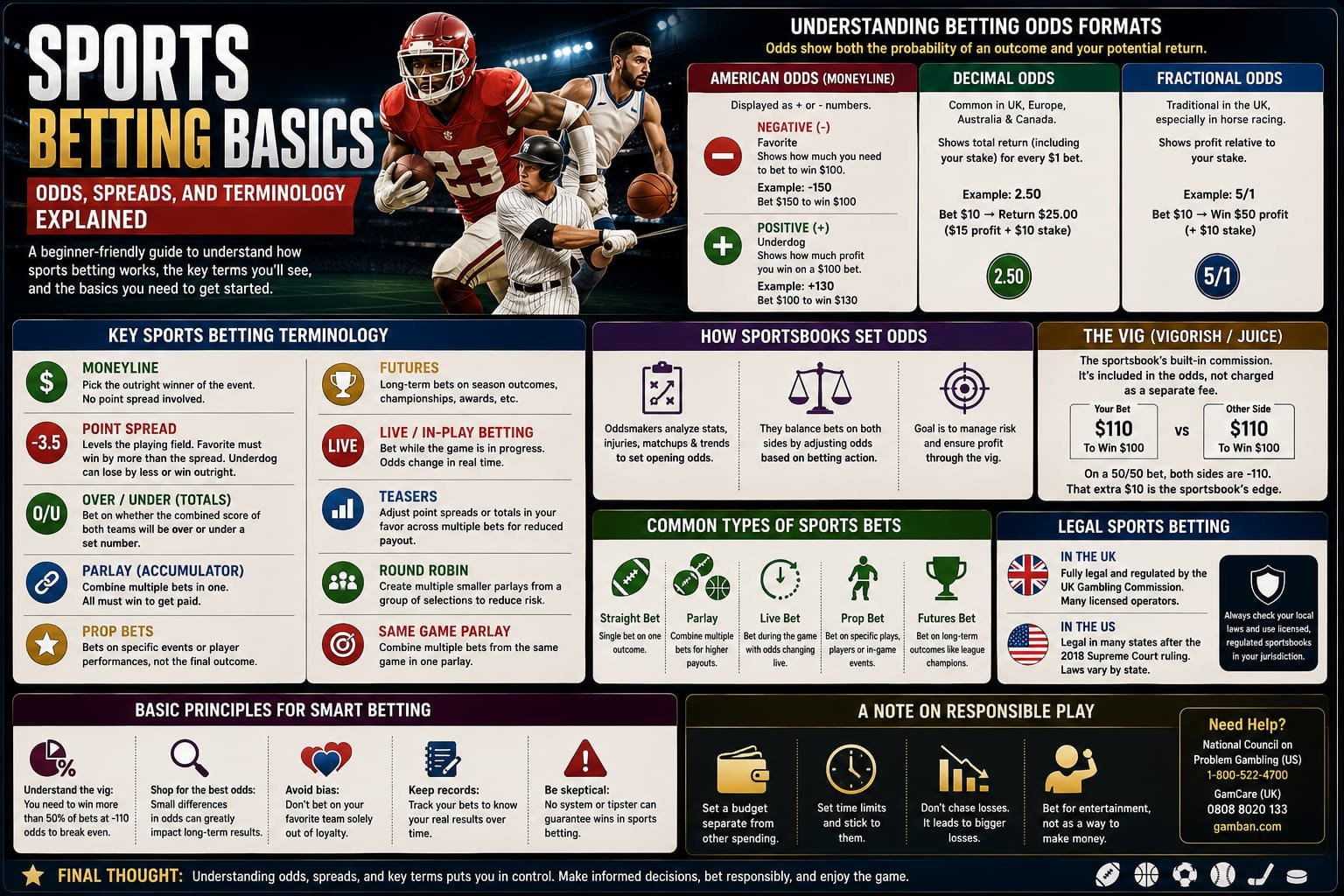
Odds represent both the probability of an outcome occurring and the potential payout for a winning bet. Different regions and platforms display odds in different formats, so understanding all three is genuinely useful.
American Odds (Moneyline)
Common in the US, these are displayed as either a positive or negative number:
- Negative numbers (e.g., -150): Indicate the favorite, and represent how much you’d need to bet to win $100. A -150 line means betting $150 wins you $100 in profit.
- Positive numbers (e.g., +130): Indicate the underdog, and represent how much profit you’d win on a $100 bet. A +130 line means a $100 bet wins $130 in profit.
Decimal Odds
Common throughout the UK, Europe, and Australia, decimal odds represent your total potential return (including your original stake) for every $1 or £1 wagered. Decimal odds of 2.50 mean a $10 bet would return $25 total ($15 profit plus your original $10 stake).
Fractional Odds
Traditionally used in the UK, particularly in horse racing, fractional odds (like 5/1 or 3/2) represent the profit relative to your stake. Odds of 5/1 mean a $10 bet would win $50 in profit (plus your original stake returned), while 3/2 means a $10 bet wins $15 profit.
Key Sports Betting Terminology
Moneyline
The simplest type of bet, where you’re simply picking which team or player will win a given event, with no consideration of margin of victory.
Point Spread
Common in sports like American football and basketball, the point spread is designed to level the playing field between a favorite and an underdog by requiring the favorite to win by more than a specified margin for a bet on them to pay out. For example, if a team is favored by -7.5, they need to win by 8 or more points for a spread bet on them to win; a bet on the underdog at +7.5 wins if they lose by 7 or fewer points, or win outright.
Over/Under (Totals)
A bet on whether the combined score of both teams in a game will be over or under a specified number set by the sportsbook, regardless of which team actually wins.
Parlay (Accumulator in the UK)
A single bet that combines multiple individual selections, all of which must win for the overall bet to pay out. Parlays offer significantly higher potential payouts than single bets, since odds multiply across each selection, but the requirement that every leg wins makes them considerably harder to hit successfully.
Prop Bets (Proposition Bets)
Bets on specific occurrences within a game that don’t directly relate to the final outcome — for example, betting on which player will score first, or how many total points a specific player will score, rather than which team wins.
Futures
Bets placed on longer-term outcomes, such as which team will win a league championship at the start of the season, settled only once the season concludes.
Live/In-Play Betting
Betting placed on a game or event while it’s actively in progress, with odds updating in real time based on what’s happening in the game.
How Sportsbooks Set Odds
Sportsbooks employ trained oddsmakers who analyze statistics, historical performance, injury reports, and various other factors to set initial odds for an event. Importantly, sportsbooks don’t just aim to predict the “true” probability of an outcome — they also adjust odds based on betting patterns to try to balance action on both sides of a bet, reducing their own risk exposure and ensuring consistent profit through their built-in commission, known as the “vig” or “juice.”
Understanding the Vig (Vigorish)
The vig is essentially the sportsbook’s built-in commission, similar in concept to the house edge in casino games. It’s typically baked into the odds themselves rather than charged as a separate fee. For example, on a straightforward 50/50 proposition, a sportsbook might offer both sides at odds of -110 rather than even money, meaning a bettor needs to wager $110 to win $100 on either side — the gap between these numbers represents the sportsbook’s built-in profit margin.
Common Types of Sports Bets Beyond the Basics
Teasers: A variation of parlay betting that allows you to adjust point spreads or totals in your favor across multiple selections, in exchange for reduced overall payout odds.
Round Robin: A way of combining multiple parlays from a larger group of selections, spreading risk across several smaller parlay combinations rather than requiring every single selection to win in one large parlay.
Same Game Parlay: A parlay combining multiple bets within a single game, such as combining a moneyline pick with a specific player prop bet from the same match.
Legal Sports Betting in the US and UK
In the UK: Sports betting has long been legal and regulated under the UK Gambling Commission, with a well-established market of licensed operators offering both online and in-person betting.
In the US: Following the 2018 Supreme Court ruling that struck down the federal ban on sports betting outside Nevada, individual states have gradually legalized and regulated sports betting, though the specific rules, available operators, and even which types of bets are permitted vary considerably from state to state. Always confirm the legal status of sports betting in your specific state, and only use operators licensed within your state’s regulated market.
Basic Principles for Approaching Sports Betting
Understand that the vig means you need to win more than 50% of bets just to break even on standard -110 style odds, not merely win more often than you lose in raw terms.
Shop for the best odds where legally possible, since even small differences in odds between operators can meaningfully affect long-run returns.
Avoid betting based purely on loyalty to your favorite team, since this can cloud objective analysis of the actual matchup.
Keep records of your betting activity, which provides an honest, unbiased picture of your actual results over time, rather than relying on memory, which tends to overweight memorable wins and underweight routine losses.
Be skeptical of “guaranteed win” tipster services or systems, since no legitimate service can guarantee outcomes in fundamentally uncertain sporting events.
A Note on Responsible Play
Sports betting can feel different from casino games because it involves an element of genuine knowledge and analysis, but it’s important to remember that sports outcomes remain fundamentally uncertain, and the sportsbook’s built-in vig means the odds are structured to favor the house over time, regardless of your knowledge of the sport. Set a clear budget for sports betting, separate from other spending, and avoid chasing losses by increasing bet sizes after a losing streak. If sports betting ever starts to feel difficult to control, resources like the National Council on Problem Gambling (US) or GamCare (UK) offer free, confidential support.
Final Thoughts
Sports betting terminology can feel intimidating at first, but the core concepts — odds formats, spreads, moneylines, and the sportsbook’s built-in vig — are straightforward once explained clearly. Understanding these fundamentals gives you a much more informed foundation for engaging with sports betting as an entertaining, if fundamentally uncertain, way to add extra interest to the games you already enjoy watching.