
Poker occupies a unique space in the casino world — part game of chance, part game of skill, and entirely built around reading people as much as reading cards. Whether you’re drawn to it because of televised World Series of Poker final tables or simply want to understand what your friends are talking about during game night, this guide walks through the fundamentals every beginner needs to get started with confidence.
What Makes Poker Different From Other Casino Games
Unlike slots or roulette, where you’re playing against the house, most poker formats involve playing against other players, with the house simply taking a small commission (called the “rake”) for hosting the game. This fundamentally changes the nature of the game — your success depends not just on the cards you’re dealt, but on how well you read opponents, manage your bankroll, and make strategic decisions under uncertainty.
Texas Hold’em: The Most Popular Format
While there are many poker variants, Texas Hold’em has become by far the most widely played format both online and in physical casinos, largely due to its popularity in televised tournaments. We’ll use it as the foundation for explaining core poker concepts.
How a Hand of Texas Hold’em Works
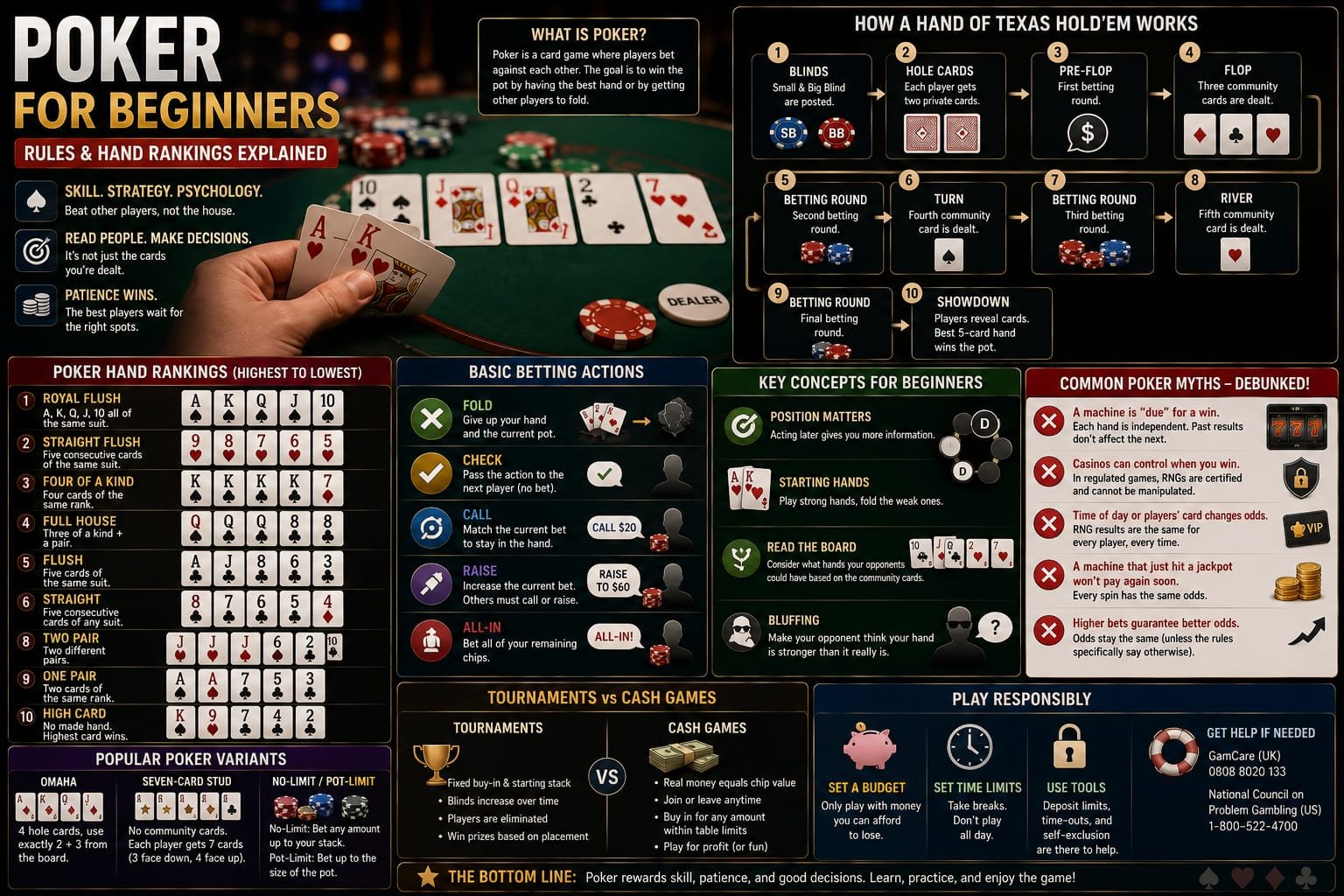
- Blinds are posted: Two players (rotating each hand) post forced bets called the small blind and big blind, ensuring there’s always money in the pot to play for
- Hole cards are dealt: Each player receives two private cards, face down, visible only to themselves
- Pre-flop betting round: Starting from the player after the big blind, each player can fold, call, or raise
- The flop: Three community cards are dealt face up in the center of the table, shared by all players
- Second betting round
- The turn: A fourth community card is dealt
- Third betting round
- The river: A fifth and final community card is dealt
- Final betting round
- Showdown: Remaining players reveal their hole cards, and the best five-card hand (using any combination of hole cards and community cards) wins the pot
Poker Hand Rankings, From Highest to Lowest
Understanding hand rankings is the absolute foundation of playing poker, since every decision ultimately relates back to the relative strength of your hand:
- Royal Flush: A, K, Q, J, 10, all of the same suit — the best possible hand
- Straight Flush: Five consecutive cards of the same suit
- Four of a Kind: Four cards of the same rank
- Full House: Three cards of one rank, plus two cards of another rank
- Flush: Five cards of the same suit, not in sequence
- Straight: Five consecutive cards of mixed suits
- Three of a Kind: Three cards of the same rank
- Two Pair: Two separate pairs of matching rank
- One Pair: Two cards of the same rank
- High Card: When no other hand is made, the highest individual card determines the winner
Basic Betting Actions
Fold: Give up your hand and any claim to the current pot, losing any chips already wagered in that hand.
Check: Decline to bet while keeping your hand active, only available when no one before you has placed a bet in the current round.
Call: Match the current bet amount to stay in the hand.
Raise: Increase the size of the current bet, requiring other players to match your new amount (or raise further) to remain in the hand.
All-in: Wager your entire remaining chip stack in a single bet.
Key Beginner Concepts
Position Matters
Where you sit relative to the dealer button significantly affects strategy. Players who act later in a betting round have more information (having seen how earlier players acted) before making their own decision, which is a meaningful strategic advantage. This is why hands that might be worth playing from a late position are often better folded from an early position.
Starting Hand Selection
Not all two-card starting hands are created equal. Strong starting hands (like a pair of Aces, Kings, or Ace-King suited) offer significantly better odds of winning than weak hands (like a low, unsuited, unconnected combination such as 7-2). Beginners often lose chips unnecessarily by playing too many weak starting hands out of impatience or boredom.
Reading the Board
As community cards are revealed, it’s important to consider not just your own hand, but what hands your opponents could plausibly be holding based on the board texture (for example, whether three cards of the same suit are showing, which raises the possibility that an opponent has a flush).
Bluffing
Because poker involves incomplete information — you can’t see your opponents’ cards — players sometimes bet or raise with a weaker hand than their betting suggests, attempting to convince opponents to fold stronger hands. Bluffing is a legitimate and important part of poker strategy, but it requires careful judgment about your opponent’s tendencies and the story your own betting pattern is telling.
Common Poker Variants Beyond Texas Hold’em
Omaha: Similar structure to Hold’em, but players receive four hole cards instead of two, and must use exactly two of their hole cards combined with three community cards to make their best hand.
Seven-Card Stud: An older format without community cards, where each player receives a combination of face-up and face-down cards over several betting rounds.
Pot-Limit and No-Limit variations: These refer to betting structures — in no-limit games, players can bet any amount up to their entire stack at any time, while pot-limit restricts maximum bets to the current size of the pot.
Tournament Play vs Cash Games
Cash games use real money values matching the chips on the table, and players can join or leave at any time, buying in for whatever amount they choose within the table’s stated limits.
Tournament play involves a fixed buy-in, with all players starting with an equal chip stack. Blinds increase at set intervals, and players are eliminated as they lose all their chips, continuing until one player holds all the chips at the table (or in larger tournaments, until a predetermined number of players remain, sharing a prize pool based on their finishing position).
Why Poker Rewards Skill More Than Most Casino Games
Because poker is played against other players rather than the house, skilled, experienced players can gain a genuine long-term statistical edge over less experienced opponents — something that isn’t possible in games like slots or roulette, where the house edge applies uniformly regardless of player skill. That said, short-term variance (“bad beats,” where a statistically favored hand still loses) is a real and normal part of poker, even for highly skilled players, due to the inherent randomness of card distribution.
A Note on Responsible Play
While poker does reward skill more than many casino games, it’s still gambling, and losses are a real possibility even for experienced players during any given session. Set a clear bankroll for poker play, separate from other spending, and avoid the temptation to “chase” losses by playing beyond your intended budget or moving to higher stakes than you’re comfortable with. If poker play ever starts to feel difficult to control, resources like GamCare (UK) or the National Council on Problem Gambling (US) offer free, confidential support.
Final Thoughts
Poker’s blend of mathematics, psychology, and strategic decision-making is what makes it endlessly fascinating to players at every skill level. Starting with a solid understanding of hand rankings, betting actions, and basic strategic concepts like position and starting hand selection gives you a genuine foundation to build on — and unlike many casino games, continued study and practice can meaningfully improve your results over time.