

Ask any experienced casino player what separates a sustainable, enjoyable hobby from a stressful, regrettable one, and most will point to the same answer: bankroll management. It’s not the most glamorous topic in gambling, but it’s arguably the most important practical skill any player can develop. This guide covers exactly how to think about and manage your gambling budget, regardless of which games you enjoy.
What Is a “Bankroll”?
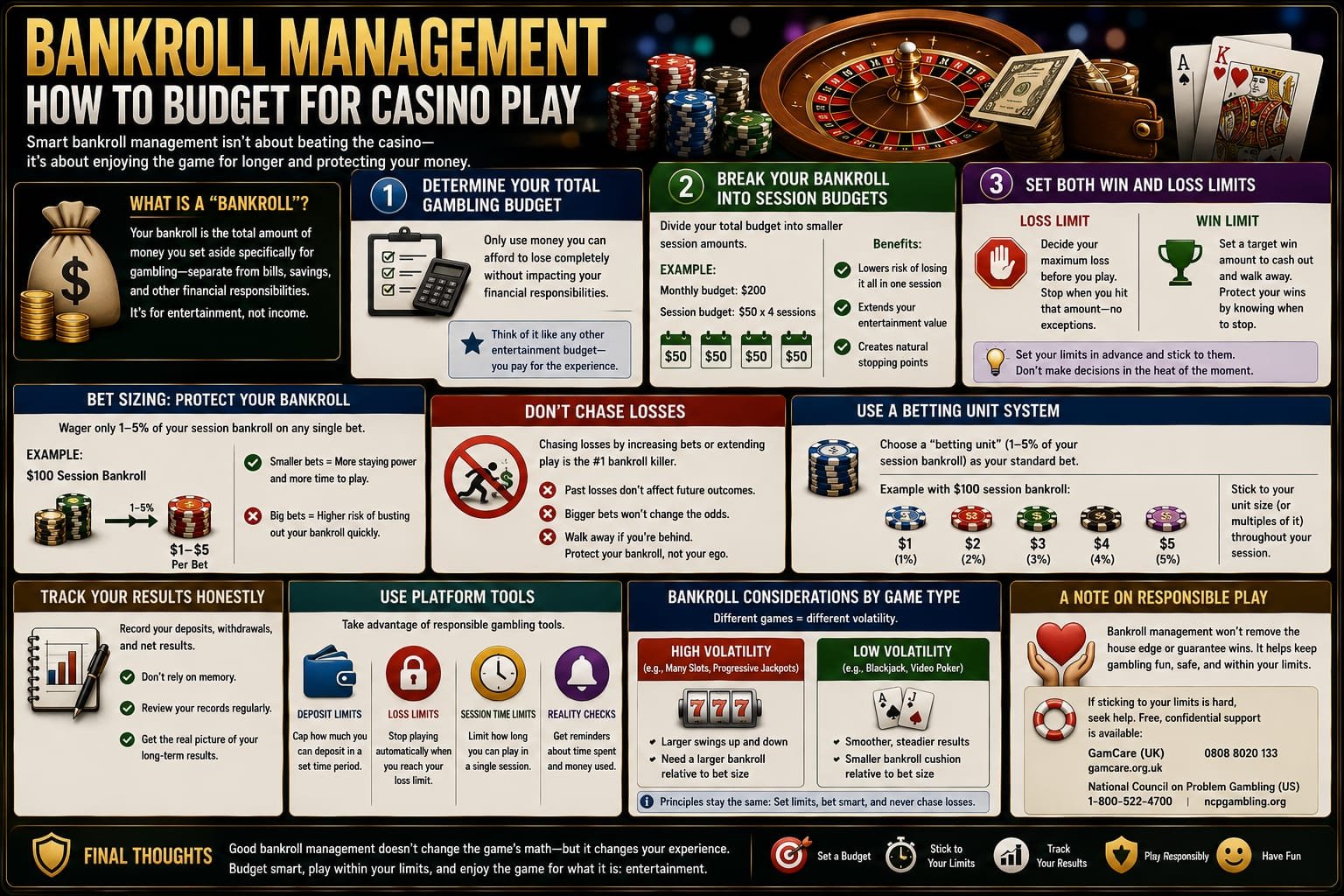
Your bankroll is simply the total amount of money you’ve specifically set aside for gambling — separate from your regular living expenses, savings, or other financial obligations. Proper bankroll management is the practice of structuring how you use that money across sessions in a way that maximizes your entertainment value while minimizing the risk of significant financial harm.
Step 1: Determine Your Total Gambling Budget
This is a deeply personal figure that depends entirely on your individual financial situation, but the guiding principle is universal: only allocate money you can genuinely afford to lose completely, without it affecting your ability to pay bills, save for important goals, or meet other financial responsibilities.
A practical way to think about this: treat your gambling budget the same way you’d think about a budget for any other entertainment activity, like dining out, going to concerts, or subscribing to streaming services. It’s money spent for the experience and enjoyment of playing, not an investment or income source you’re counting on.
Step 2: Break Your Bankroll Into Session Budgets
Once you’ve established a total gambling budget (say, for a month), it’s worth dividing that amount into smaller session budgets rather than treating your entire bankroll as available for a single sitting. For example, if your monthly gambling budget is $200, you might decide to divide this into four $50 session budgets, spread across the month, rather than risking the entire amount in one visit.
This approach offers a few genuine benefits:
- Reduces the risk of losing your entire budget in a single unlucky session
- Extends your overall entertainment value across more sessions
- Creates natural stopping points, reducing the temptation to keep playing indefinitely in pursuit of a comeback
Step 3: Set Both Win and Loss Limits
Effective bankroll management isn’t just about limiting losses — it also involves deciding in advance when you’ll stop if you’re winning, which is a discipline many players overlook.
Loss limit: Decide before you start playing exactly how much you’re willing to lose in a session, and commit to stopping once you reach that limit, regardless of how the session has gone or how convinced you might feel that a turnaround is imminent.
Win limit: Similarly, decide on a target amount where, if reached, you’ll consider ending the session while ahead, rather than continuing indefinitely and risking giving back your winnings (and potentially more) through continued play.
Setting both limits in advance — ideally writing them down or using built-in platform tools like deposit and loss limits — removes the need to make these decisions in the heat of the moment, when judgment can be clouded by the emotional highs and lows of active play.
Understanding Bet Sizing Relative to Your Bankroll
How much you wager per bet or per spin should be proportional to your overall session bankroll, not just based on what feels exciting in the moment. A commonly referenced guideline among experienced players is to avoid wagering more than 1-5% of your session bankroll on any single bet, which helps ensure your bankroll can weather a reasonable losing streak (which, statistically, will happen periodically in any gambling activity) without being wiped out immediately.
For example, with a $100 session bankroll, keeping individual bets in the $1-5 range provides considerably more staying power and playing time than repeatedly wagering $20-25 per bet, which could exhaust your entire bankroll in just a handful of unlucky outcomes.
Why Chasing Losses Is the Single Biggest Bankroll Management Mistake
“Chasing losses” refers to the common but genuinely risky behavior of increasing bet sizes or extending play specifically to try to win back money already lost. This is worth addressing directly because it’s one of the clearest paths from casual, entertainment-focused gambling toward genuinely harmful patterns.
The problem with chasing losses is that it fundamentally misunderstands how independent random events work — previous losses have no bearing on future outcomes, meaning there’s no mathematical basis for believing a “comeback” is more likely after a losing streak than at any other time. Increasing bets specifically to recover losses simply increases your financial exposure without improving your actual odds, and can turn a manageable loss into a significantly larger one.
If you notice yourself increasing bet sizes specifically because you’re behind for the session, this is a clear signal to stop and walk away rather than continue.
Using a Betting Unit System
Some experienced players find it helpful to establish a standard “betting unit” — a fixed base amount representing a single standard bet — calculated as a small percentage of their overall session bankroll. This creates a consistent framework for bet sizing throughout a session, rather than making ad hoc decisions about bet size based on mood or recent results, which can lead to inconsistent, poorly calibrated betting patterns.
Tracking Your Results Honestly
Keeping an honest record of your gambling activity — total deposits, total withdrawals, and net results over time — provides invaluable perspective that’s easy to lose track of through memory alone. Human memory tends to disproportionately recall notable wins while downplaying the cumulative effect of smaller, more routine losses, creating a skewed impression of overall results if you’re relying purely on recollection rather than actual figures.
Many regulated online casinos provide account history and transaction records that make this tracking straightforward — reviewing this periodically, even if it’s uncomfortable, provides a genuinely useful reality check on your actual gambling patterns and results.
Using Platform Tools to Support Bankroll Discipline
Regulated online casinos are required to offer several tools that can directly support bankroll management:
- Deposit limits: Cap how much you can add to your account within a set timeframe
- Loss limits: Automatically prevent further play once you’ve reached a predetermined loss threshold
- Session time limits: Restrict how long you can play in a single sitting
- Reality checks: Periodic reminders of session duration and spending during play
Setting these tools proactively, before you feel they’re necessary, builds a structural safeguard around your bankroll management goals that doesn’t rely purely on in-the-moment willpower.
Bankroll Management Across Different Games
Different casino games naturally involve different bankroll considerations. Higher-volatility games (like many slots) can produce larger swings, requiring a larger bankroll relative to your bet size to comfortably weather losing streaks without exhausting your budget prematurely. Lower-volatility games and lower house-edge games (like blackjack with basic strategy) tend to produce steadier, more gradual results, which can be managed with a somewhat smaller bankroll cushion relative to bet size, though the fundamental principles of setting limits and avoiding loss-chasing remain identical across every game type.
A Note on Responsible Play
Bankroll management is ultimately a practical tool for responsible gambling — it doesn’t eliminate the house edge or guarantee positive outcomes, but it significantly reduces the risk of gambling causing genuine financial harm, and helps keep the activity firmly within the realm of enjoyable entertainment. If you find that sticking to your bankroll limits is consistently difficult despite genuine effort, this is worth taking seriously, and free, confidential support is available through resources like GamCare (UK) or the National Council on Problem Gambling (US).
Final Thoughts
Good bankroll management won’t change the underlying mathematics of casino games, but it fundamentally shapes your overall experience — determining whether gambling remains an enjoyable, controlled form of entertainment or drifts into something more stressful and financially risky. Setting a clear total budget, dividing it into manageable session amounts, establishing both win and loss limits in advance, and tracking your results honestly are practical, achievable habits that meaningfully protect both your finances and your overall enjoyment of casino gaming.