
For years, one of the biggest criticisms of online casinos was the loss of atmosphere — no real dealer, no other players visible at the table, just you and a screen. Live dealer games emerged specifically to solve this problem, blending the convenience of online play with the authenticity of a real casino floor. This guide explains exactly how live dealer technology works and what to expect from the experience.
What Are Live Dealer Games?
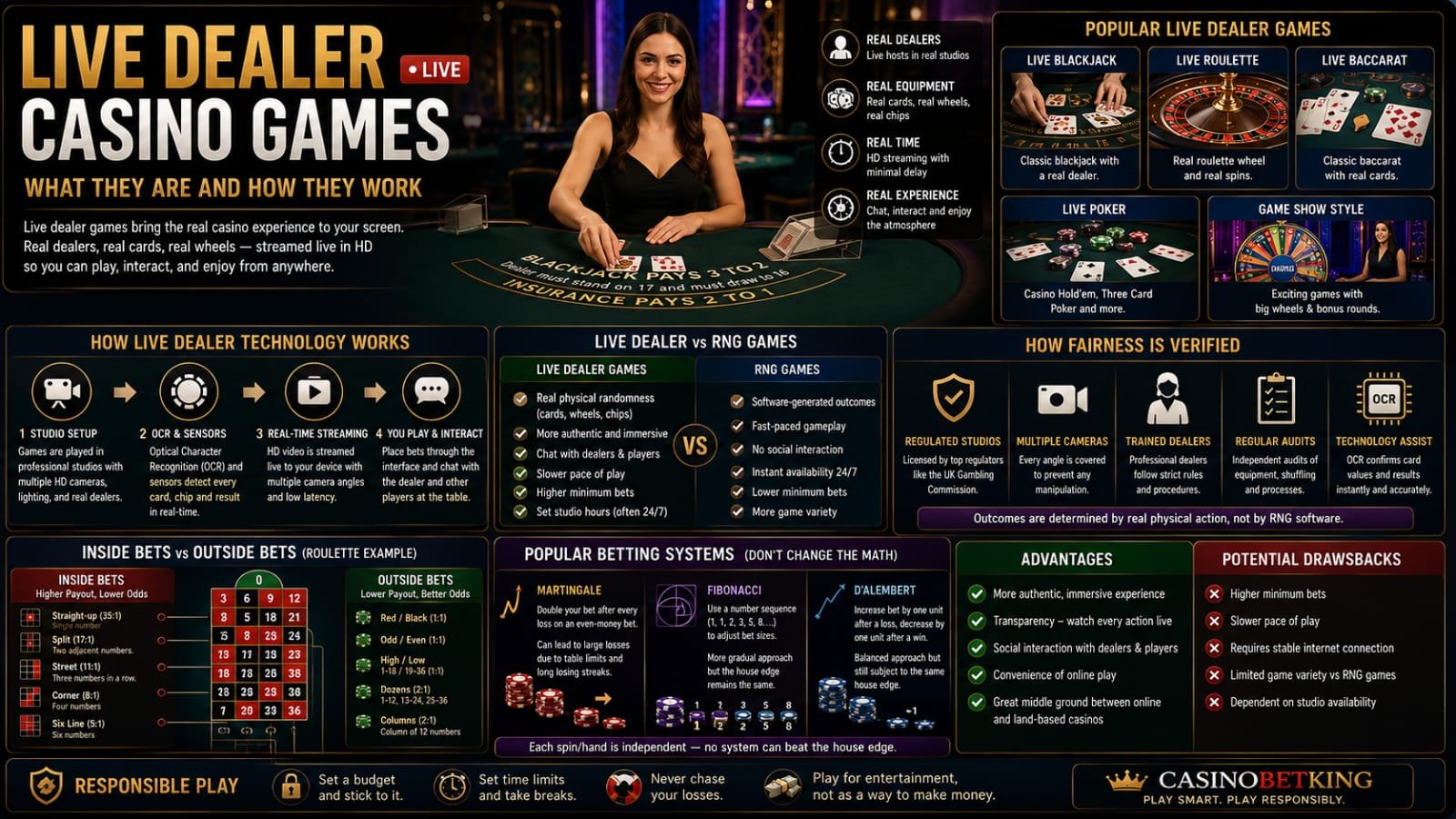
Live dealer casino games are real casino games — blackjack, roulette, baccarat, poker, and others — hosted by an actual human dealer or croupier, operating genuine physical equipment (real cards, a real roulette wheel, real chips) in a professionally equipped studio or, in some cases, an actual casino floor. The action is streamed in real time via high-definition video to players connecting from their computers or mobile devices, who can place bets and interact with the game through their screen.
Unlike standard digital casino games, which rely entirely on Random Number Generator (RNG) software to determine outcomes, live dealer games use actual physical randomness — a real shuffled deck, a real spinning wheel — much closer to what you’d experience at a physical casino table.
How the Technology Actually Works
The Studio Setup
Live dealer games are typically filmed in dedicated studios built and operated by specialized live casino software providers, who then supply the live-streamed content to multiple online casino operators. These studios are equipped with professional lighting, multiple camera angles, and specialized table setups designed for optimal video capture.
Optical Character Recognition (OCR) and Sensors
This is where the real technical sophistication comes in. Live dealer tables use built-in sensors and optical character recognition technology to instantly detect and digitize physical events — for example, recognizing which card has been dealt, or where a roulette ball has landed — and translate that information into the digital interface players see on their screen in real time. This allows the system to accurately track game state, calculate payouts, and update the interface, all while the dealer conducts the actual physical game.
Real-Time Streaming
High-definition video feeds, often from multiple camera angles (a wide shot of the table, a close-up on the cards or wheel, and sometimes a dedicated angle on the dealer), are streamed to players with minimal latency, creating an experience that feels close to real-time despite the technical complexity involved in coordinating physical action, digital tracking, and remote video delivery simultaneously.
Player Interaction
Players place bets through a digital interface overlaid on the video stream, and many live dealer platforms include chat functionality, allowing players to communicate with the dealer and sometimes other players at the same virtual table, adding a social element that purely digital RNG games lack.
Common Live Dealer Games
Live Blackjack: Follows standard blackjack rules, with a real dealer dealing physical cards, often to multiple simultaneous players who each have their own virtual “seat” at the table.
Live Roulette: Features a real roulette wheel and ball, with the outcome determined by actual physical spins rather than an RNG algorithm.
Live Baccarat: Uses real cards dealt by a live dealer, following standard baccarat rules and payouts.
Live Poker (various formats): Including live versions of games like Casino Hold’em or Three Card Poker, played against the dealer rather than other players.
Game Show-Style Live Games: A newer category blending live dealer mechanics with game show elements — large spinning wheels, bonus rounds, and interactive multipliers — designed to add entertainment value beyond traditional table game formats.
Live Dealer vs Standard RNG Games: Key Differences
Authenticity: Live dealer games use genuine physical randomness (real cards, real wheels) rather than software-generated outcomes, which some players find more trustworthy or simply more enjoyable to watch unfold.
Pace of play: Live dealer games generally move at a more measured pace than RNG-based digital games, since they’re constrained by the real-world time it takes to shuffle cards, spin a wheel, or deal a hand — some players prefer this slower, more deliberate pace, while others find purely digital games more efficient for quick sessions.
Social element: The ability to chat with a live dealer and, in some formats, see other players at the table adds a social dimension that purely digital games don’t replicate.
Availability: Live dealer games operate on set schedules tied to studio operating hours (though many run 24/7), whereas RNG-based digital games are available instantly, any time, without needing an active dealer.
Betting limits: Live dealer tables often have higher minimum bets compared to digital RNG versions of the same game, since operating physical studios with live staff involves higher overhead costs than running purely software-based games.
How Fairness Is Verified in Live Dealer Games
Because live dealer games don’t rely on RNG software for the core game outcome, fairness verification works somewhat differently. Regulated live dealer studios are subject to strict operational standards, including:
- Regular independent audits of studio equipment and shuffling procedures
- Multiple camera angles specifically positioned to prevent any possibility of manipulation
- Trained, licensed dealers following standardized procedures
- Licensing requirements from the same regulatory bodies (like the UK Gambling Commission) that oversee standard online casino operations
Some live dealer roulette and card-related features do still use technology to assist in outcome verification — for example, confirming card values through OCR technology — but the fundamental outcome (which card is dealt, where the ball lands) is determined by genuine physical randomness, not software generation.
Advantages of Live Dealer Games
- A more authentic, immersive casino atmosphere compared to standard digital games
- Transparency — you can visually watch the actual shuffle, deal, or spin happen in real time, rather than trusting an unseen algorithm
- Social interaction with dealers and, in some cases, other players
- A middle ground between the convenience of online play and the experience of a physical casino visit
Potential Drawbacks to Consider
- Higher minimum bets compared to equivalent RNG digital games
- Slower pace of play, which may not suit players who prefer rapid-fire sessions
- Dependent on stable internet connectivity for a smooth streaming experience
- Limited game variety compared to the vast library of digital slots and RNG table game variations available at most online casinos
A Note on Responsible Play
The social, immersive nature of live dealer games — combined with typically higher minimum bets — means sessions can potentially involve larger sums of money moving more quickly than standard digital games. It’s worth setting a clear budget and time limit before joining a live dealer table, just as you would with any other form of casino play, and treating the experience as entertainment rather than a source of income.
Final Thoughts
Live dealer games represent one of the more genuinely innovative developments in online gambling technology, successfully bridging the gap between digital convenience and the authentic atmosphere of a physical casino floor. Understanding how the underlying technology works — the studio setup, real-time tracking, and live streaming — can help you appreciate what’s actually happening behind the scenes, and decide whether this more immersive, socially engaging format suits your preferences compared to standard RNG-based digital games.