

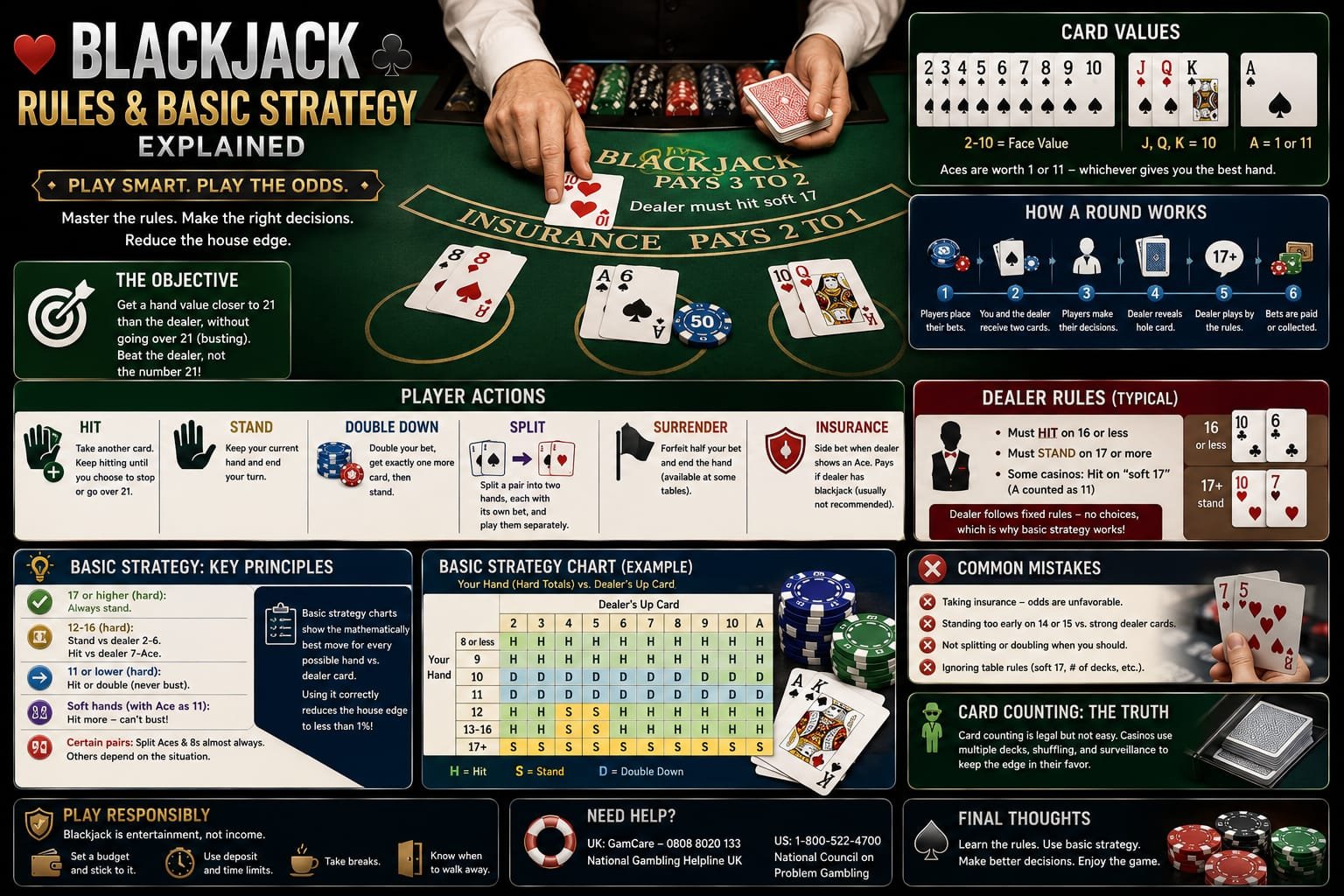
Blackjack holds a unique place in the casino world — it’s one of the few games where skillful play genuinely reduces the house edge to some of the lowest levels found on any casino floor. Unlike slots or roulette, where outcomes are purely down to chance, blackjack rewards players who understand the game’s mathematics. This guide walks through the rules from scratch and explains basic strategy in a way that actually makes sense.
The Objective of Blackjack
Despite its reputation for complexity, blackjack’s core objective is simple: get a hand value closer to 21 than the dealer’s hand, without going over 21 (known as “busting”). You’re not trying to hit exactly 21 every time — you’re simply trying to beat the dealer’s final hand total.
Card Values
- Number cards (2-10): Worth their face value
- Face cards (Jack, Queen, King): Each worth 10
- Aces: Worth either 1 or 11, whichever benefits your hand more — this flexibility is why aces are so valuable
How a Round of Blackjack Works
- Players place their bets before any cards are dealt
- Each player receives two cards, face up
- The dealer receives two cards — typically one face up and one face down (the “hole card”), though rules vary slightly by casino
- Players then decide how to play their hand, one at a time, using the actions described below
- Once all players have acted, the dealer reveals their hole card and plays their hand according to fixed rules (explained below)
- Bets are paid out or collected based on the final comparison between each player’s hand and the dealer’s hand
Player Actions Explained
Hit: Take another card, adding it to your hand total. You can hit as many times as you like, as long as you don’t bust.
Stand: Keep your current hand total and take no further cards, ending your turn.
Double Down: Double your original bet in exchange for receiving exactly one more card, then automatically standing. This is typically used when your first two cards give you strong odds of ending up with a powerful hand.
Split: If your first two cards are a matching pair (like two 8s), you can split them into two separate hands, each with its own bet equal to your original wager, and play them independently.
Surrender: Available at some tables, this lets you forfeit half your bet and end the hand immediately, useful in situations where the odds are heavily stacked against you.
Insurance: Offered when the dealer’s face-up card is an Ace, this is a side bet that pays out if the dealer has blackjack. Despite the name, most professional players and mathematicians advise against taking insurance, since the odds are generally unfavorable for the player over the long run.
How the Dealer Plays
Unlike players, the dealer doesn’t get to make strategic choices — they must follow fixed rules, typically:
- The dealer must hit on any hand total of 16 or less
- The dealer must stand on a hand total of 17 or more (though some casinos use a rule where the dealer hits on a “soft 17” — a hand containing an ace counted as 11 — so it’s worth checking the table rules)
This fixed structure is actually central to how basic strategy is calculated, since the dealer’s predictable behavior allows mathematicians to calculate the statistically optimal way for players to act in every possible situation.
What Is Blackjack (Natural 21)?
If your first two cards total 21 — meaning an Ace paired with any 10-value card — this is called a “blackjack” or “natural,” and it typically pays out at 3:2 (meaning a $10 bet wins $15), better than a standard win. If both the dealer and player have blackjack, the hand is a “push” (tie), and the player’s original bet is returned.
Understanding Basic Strategy
Basic strategy refers to a mathematically derived set of decisions — computed through extensive statistical analysis and computer simulation — that tells you the optimal action (hit, stand, double, or split) for every possible combination of your hand and the dealer’s face-up card. Following basic strategy perfectly reduces the house edge in blackjack to typically less than 1%, among the lowest of any casino game, though the exact figure varies slightly depending on specific table rules.
Key Basic Strategy Principles
When you have a hard total of 17 or higher: Always stand, regardless of the dealer’s face-up card, since the risk of busting is too high to justify hitting.
When you have a hard total of 12-16: Your decision depends heavily on the dealer’s face-up card. Generally, if the dealer shows a weak card (2 through 6), you stand, since there’s a higher statistical chance the dealer will bust. If the dealer shows a strong card (7 through Ace), you generally hit, since the dealer is less likely to bust and you need a stronger hand to compete.
When you have a hard total of 11 or less: You can never bust by hitting, so hitting (or doubling, in favorable situations) is almost always correct.
Soft hands (containing an Ace counted as 11): These offer more flexibility since you can’t bust by hitting — a soft 13 (Ace + 2), for example, can safely take another card since the Ace can revert to counting as 1 if needed.
Pairs: Certain pairs, like Aces and 8s, are almost always worth splitting, since a hand of two 8s (totaling a weak 16) becomes two separate hands each starting from a much stronger position.
Because the correct decision varies by both your hand and the dealer’s up card, most serious players use a basic strategy chart — widely available online — as a reference until the decisions become second nature through repetition.
Common Mistakes Beginners Make
Taking insurance too often: As mentioned, the math generally doesn’t favor this side bet, despite its appeal as a “safety net.”
Standing too early on weak hands: New players often stand on totals like 14 or 15 out of fear of busting, even when the dealer’s up card statistically favors hitting.
Not understanding when to split or double: These moves can significantly improve your expected value in the right situations, but are often underused by beginners unfamiliar with basic strategy.
Ignoring table rules: Small rule variations — like whether the dealer hits or stands on soft 17, or how many decks are in play — can meaningfully shift the house edge, so it’s worth understanding a table’s specific rules before playing.
Card Counting: Separating Myth From Reality
Blackjack’s reputation for being “beatable” largely stems from card counting — a technique made famous by MIT students and Hollywood films, involving tracking the ratio of high to low cards remaining in the deck to gain a statistical edge on certain hands. While card counting is not illegal, casinos are private businesses and can legally refuse service to players they suspect of counting. In practice, modern casinos use multiple-deck shoes, frequent shuffling, and surveillance technology specifically designed to make effective card counting extremely difficult for the average player.
A Note on Responsible Play
Even with perfect basic strategy, blackjack still carries a house edge — meaning the odds remain statistically in the casino’s favor over time, even if individual sessions can go either way. Basic strategy is a tool for minimizing losses and maximizing entertainment value over a session, not a guaranteed path to profit. Set a budget before you sit down at a table, treat any losses as the cost of entertainment, and use available responsible gambling tools if you ever feel your play is becoming difficult to control.
Final Thoughts
Blackjack remains one of the most engaging and strategically rich games on the casino floor precisely because your decisions genuinely matter. Learning basic strategy — even just the core principles outlined here — will meaningfully improve your odds compared to playing by instinct alone, and understanding the reasoning behind each decision makes the game far more enjoyable to play thoughtfully rather than randomly.