

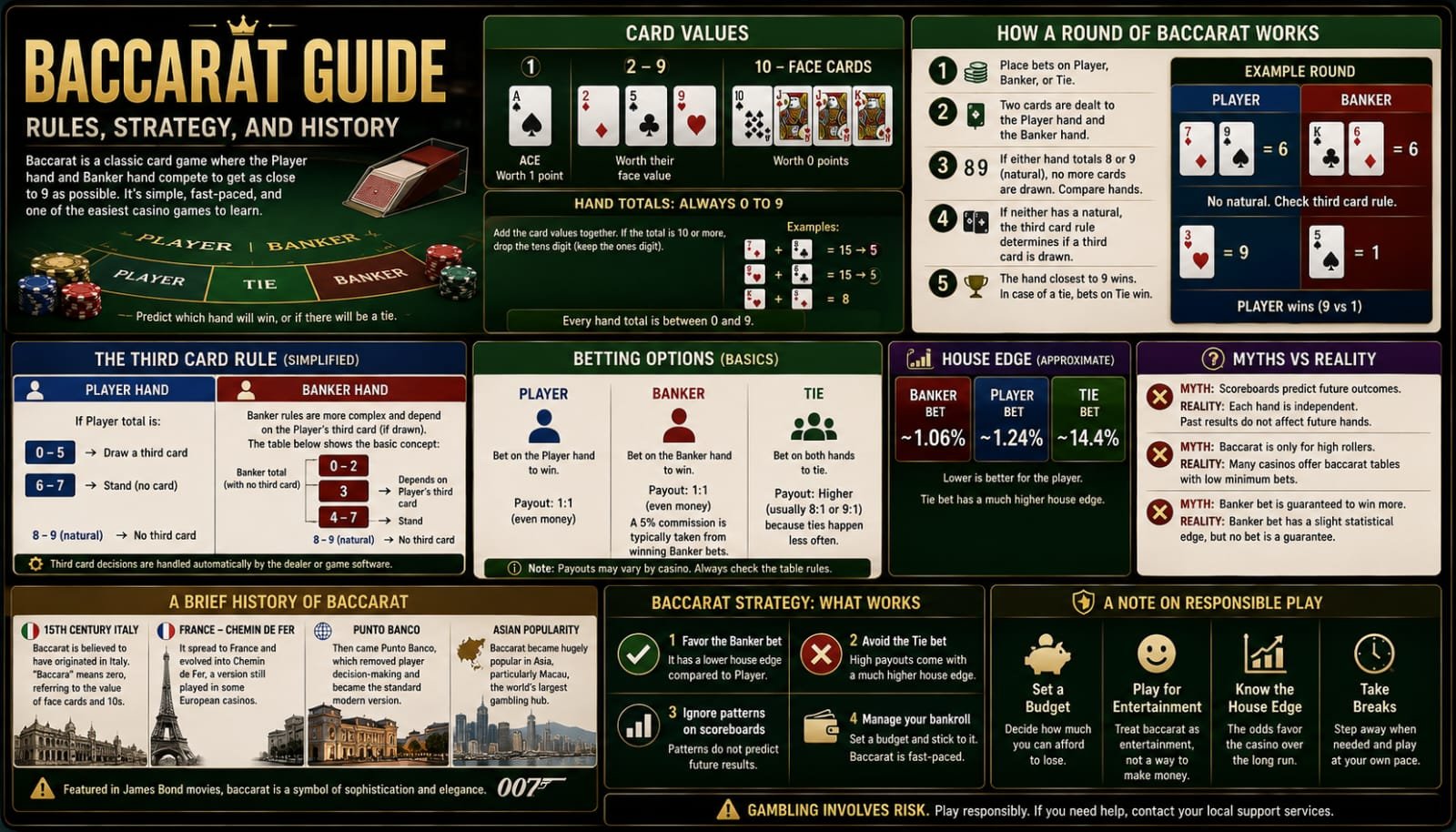
Baccarat has a reputation as an elegant, high-stakes game favored by James Bond and high rollers in exclusive casino lounges — but in reality, it’s one of the simplest casino games to learn, with no complex decisions required once you understand the basic rules. This guide walks through everything from the fundamentals to a bit of the game’s fascinating history.
The Objective of Baccarat
Baccarat is played between two hands — the “Player” hand and the “Banker” hand — and your job as a bettor is simply to predict which hand will have a final value closer to 9, or whether the hands will tie. Despite the names, you don’t have to bet on the “Player” hand to be the player, or the “Banker” hand to be the dealer — these are simply the names of the two competing hands, and you can bet on either one, or on a tie, regardless of your seat at the table.
Card Values in Baccarat
- Aces: Worth 1 point
- Number cards 2-9: Worth their face value
- 10s and face cards (Jack, Queen, King): Worth 0 points
How Hand Totals Work
This is the aspect of baccarat that trips up newcomers most: hand totals are calculated by adding card values together and then dropping the tens digit if the total exceeds 9. For example, a hand containing a 7 and an 8 totals 15, but in baccarat, this becomes a hand value of 5 (dropping the “1” from 15). This is why every baccarat hand ultimately has a value between 0 and 9.
How a Round of Baccarat Works
- Bets are placed on Player, Banker, or Tie before any cards are dealt
- Two cards are dealt to both the Player hand and the Banker hand
- If either hand has a total of 8 or 9 (called a “natural”), no further cards are drawn, and the hands are compared immediately
- If neither hand has a natural, additional card-drawing rules (explained below) determine whether a third card is drawn for either hand
- Once all necessary cards are dealt, the hand closest to 9 wins, and bets are paid out accordingly
The Third Card Rule
This is the most complex part of baccarat, but the good news is that you don’t actually need to memorize it to play — the dealer (or the game software, in the case of digital or RNG-based baccarat) automatically applies these rules based on a fixed table. Here’s a simplified explanation:
For the Player hand: If the Player’s first two cards total 6 or 7, they stand. If the total is 0-5, they draw a third card.
For the Banker hand: The rules are more complex and depend partly on what the Player’s third card was (if one was drawn), but generally, the Banker draws or stands based on a fixed table designed to maintain balanced odds between the two hands.
Since this process is handled automatically by the dealer or software, players don’t need to make any strategic decisions once their bet is placed — which is part of why baccarat is often considered one of the easiest casino games to play, despite looking intimidating at first glance.
Betting Options and Payouts
Player bet: Pays 1:1 (even money) if the Player hand wins.
Banker bet: Pays 1:1, though typically with a 5% commission taken by the casino on winning Banker bets, since the Banker bet statistically wins slightly more often than the Player bet due to the specific third-card drawing rules.
Tie bet: Pays significantly higher, often 8:1 or 9:1 depending on the casino, since ties occur much less frequently than a win for either the Player or Banker hand.
Understanding the House Edge in Baccarat
Baccarat is well-regarded for having some of the better odds available among popular casino games, particularly on the Banker bet:
- Banker bet: Approximately 1.06% house edge (after accounting for the standard 5% commission)
- Player bet: Approximately 1.24% house edge
- Tie bet: Approximately 14.4% house edge, significantly worse than either the Player or Banker bet, despite its appealing higher payout odds
This is why experienced baccarat players overwhelmingly favor the Banker bet, and generally avoid the Tie bet despite its tempting payout multiplier, since the actual odds of it occurring don’t come close to justifying the risk from a statistical standpoint.
Common Baccarat Myths and Misconceptions
Myth: Tracking previous outcomes on a scorecard helps predict future results.
Reality: Many baccarat tables display a “scoreboard” showing the pattern of recent Player/Banker wins, and some players use this to inform their next bet, believing in “streaks” or patterns. However, each hand is an independent event, and previous outcomes have no influence on future results — this is a version of the same gambler’s fallacy that affects roulette players.
Myth: Baccarat is only for high rollers.
Reality: While baccarat has a historical association with high-stakes play, particularly in Asian casino markets where it’s extremely popular, most online and physical casinos offer baccarat tables with minimum bets accessible to casual players.
Myth: The Banker bet is “protected” or guaranteed to win more.
Reality: The Banker bet does have a statistical edge over the Player bet due to the specific third-card rules, but it’s still not a guaranteed winner on any individual hand — it simply carries a slightly better long-run probability, which is why the casino charges a commission on it to help balance the house’s overall edge.
A Brief History of Baccarat
Baccarat’s origins are believed to trace back to 15th-century Italy, with the name possibly derived from the Italian word “baccara,” meaning zero — a reference to the value of face cards and 10s in the game. The game spread to France, where it evolved into “Chemin de Fer,” a version still played in some European casinos today, before eventually developing into “Punto Banco,” the version most commonly played in modern casinos, which removed player decision-making entirely by fixing the third-card drawing rules.
Baccarat gained significant popularity in Asian markets, particularly Macau, which has become the largest gambling market in the world, driven substantially by baccarat’s popularity among high-stakes players. The game’s association with sophistication was further cemented by its recurring appearance in the James Bond film franchise, where Bond is frequently depicted playing baccarat in glamorous casino settings.
Baccarat Strategy: What Actually Works
Since baccarat involves no player decisions during the actual hand (card drawing is automatic), “strategy” in baccarat mostly comes down to bet selection and bankroll management:
- Favor the Banker bet for its statistically better odds, despite the commission
- Avoid the Tie bet despite its appealing payout, given its significantly higher house edge
- Ignore scoreboard patterns — they have no predictive value for future hands
- Set a clear budget and stick to it, since baccarat’s fast pace (hands typically resolve quickly) means bets can add up rapidly during a session
A Note on Responsible Play
Baccarat’s simplicity and rapid pace mean many hands can be played in a short amount of time, which is worth being mindful of when managing your budget. As with any casino game, baccarat carries a built-in house edge regardless of bet selection, meaning the odds favor the casino over the long run. Set a clear budget before playing, and treat the game as entertainment rather than a source of income.
Final Thoughts
Baccarat’s blend of simplicity, elegance, and relatively favorable odds (particularly on the Banker bet) explains its enduring popularity across both traditional casino floors and online platforms. With no complex strategic decisions required during play, understanding the betting options and their true odds is really all you need to approach the game with confidence and realistic expectations.