

If you’ve spent any time researching online casino games, you’ve probably come across the terms “RTP” and “house edge” — often tossed around in marketing materials as proof of a game’s fairness or generosity. But what do these numbers actually mean, and how should they realistically shape your expectations as a player? This guide breaks down the math behind these concepts in plain, practical terms.
What Is RTP (Return to Player)?
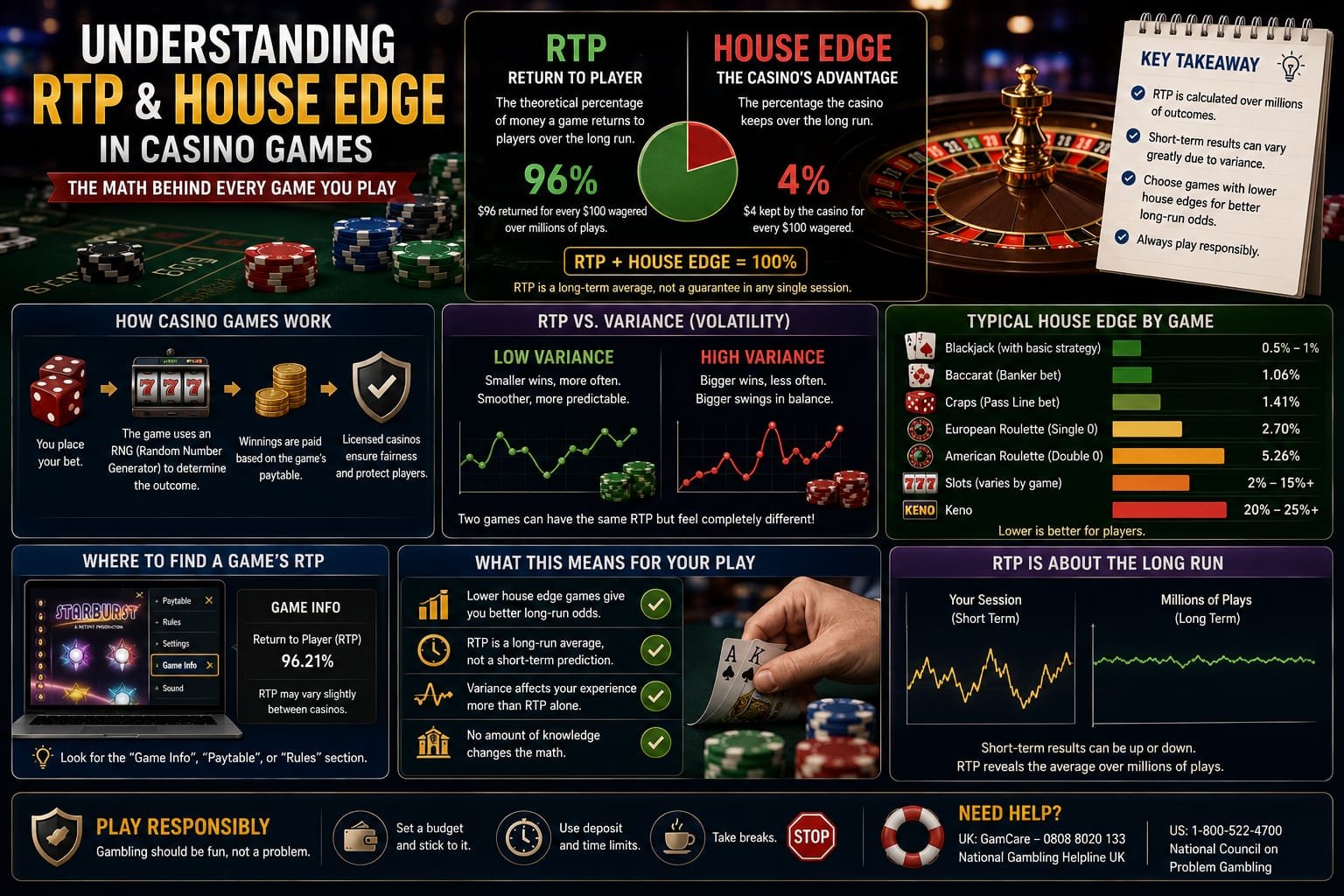
RTP, or Return to Player, is a percentage that represents the theoretical amount of money a game returns to players over a very large number of spins or hands, calculated over the long run. For example, a slot machine with a 96% RTP theoretically returns $96 for every $100 wagered across all players over an extremely large sample size — not to any single player in any single session.
This is a critical distinction that trips up a lot of players: RTP is a statistical average calculated over millions of spins, not a promise about what will happen in your next hour of play. In any individual session, you could win significantly more than the RTP suggests, or lose your entire budget, purely due to variance (explained further below).
What Is House Edge?
House edge is essentially the mirror image of RTP — it represents the statistical advantage the casino holds over players on a given game, expressed as a percentage. If a game has a 96% RTP, its house edge is 4% (100% minus RTP). This 4% represents the average amount the casino expects to keep from total wagers over the long run, which is how casinos generate consistent profit despite frequently paying out individual wins.
Every casino game has a house edge — it’s the mathematical foundation the entire industry is built on, and there’s no legitimate game without one. The size of that edge, however, varies significantly between different games and even between different bets within the same game.
Typical House Edge Ranges by Game
Understanding roughly where different games fall on the house edge spectrum can help you make more informed choices about how you allocate your time and budget:
- Blackjack (with basic strategy): Approximately 0.5%-1%, among the lowest house edges available
- Baccarat (Banker bet): Approximately 1.06%
- Craps (Pass Line bet): Approximately 1.41%
- European Roulette (single zero): Approximately 2.7%
- American Roulette (double zero): Approximately 5.26%, notably higher due to the extra zero pocket
- Slots: Highly variable, typically ranging from around 2% to 15%+ depending on the specific game and provider
- Keno: Often among the highest house edges, sometimes exceeding 20-25%
These figures illustrate why games like blackjack and baccarat are often favored by players focused on maximizing their statistical odds, while games like keno and certain slots carry a much steeper built-in disadvantage.
Understanding Variance (Volatility)
RTP tells you the long-run average outcome, but it doesn’t tell you anything about how bumpy the ride will be to get there — that’s where variance, sometimes called volatility, comes in.
Low variance games pay out smaller wins more frequently, resulting in a smoother, more predictable session with less dramatic swings in your balance.
High variance games pay out less frequently, but potential wins tend to be larger when they do occur, resulting in a session that can feel like a rollercoaster — long stretches with minimal wins punctuated by occasional big payouts.
Two slot machines could both have a 96% RTP but feel completely different to play, purely because of differing variance levels. A low-variance slot might keep your balance relatively stable with frequent small wins, while a high-variance slot could burn through your budget quickly with the possibility of a large win that may or may not arrive within your session.
Why RTP Doesn’t Guarantee Anything in the Short Term
This is perhaps the single most misunderstood aspect of RTP, and worth repeating clearly: RTP is calculated over an enormous sample size — often tens of millions of simulated spins — to arrive at a stable statistical average. In the short term (a single session, or even hundreds of spins), actual results can and often do deviate significantly from the theoretical RTP, in either direction. This is simply the nature of random probability, not evidence that a game is “hot” or “cold,” rigged, or behaving unusually.
Where to Find a Game’s RTP
Reputable online casinos and game providers typically publish RTP information, often accessible through the game’s information or “paytable” screen within the game itself. If a game doesn’t disclose its RTP anywhere, or if a casino is cagey about providing this information on request, it’s a reasonable red flag worth taking seriously when evaluating whether to play there.
Does a Higher RTP Mean You’ll Win More Often?
Not necessarily, and this is an important nuance. RTP reflects the overall percentage of wagered money theoretically returned over time, but it doesn’t directly tell you how often you’ll win, or how large individual wins will be — those factors are shaped more by a game’s variance and specific payout structure. A high-RTP, high-variance slot might still result in long losing streaks punctuated by rare large wins, while a slightly lower-RTP, low-variance game might feel more consistently rewarding session to session, even though its long-run mathematical return is technically lower.
How RTP and House Edge Should Actually Inform Your Play
Rather than treating RTP as a predictor of short-term results, it’s more useful as a comparative tool — helping you understand, roughly, which games offer better statistical odds relative to others, and setting realistic expectations about the mathematical relationship you’re entering into with any casino game.
Practical takeaways:
- Games with lower house edges (blackjack, baccarat, certain roulette bets) offer better long-run odds than higher house edge games like keno or many slots, if maximizing statistical value is a priority for you
- RTP is a long-run average, not a short-term prediction — don’t expect any individual session to mirror the published percentage
- Variance affects your experience more than RTP alone — understanding a game’s variance level can help you choose games that match your risk tolerance and bankroll size
- No amount of RTP knowledge changes the fundamental math — every casino game is designed with a house edge, meaning the casino has a statistical advantage over players in the long run, regardless of which specific game you choose
A Note on Responsible Play
Understanding RTP and house edge is valuable knowledge, but it’s not a strategy for guaranteed profit — no such strategy exists in casino gambling, and any platform or individual claiming otherwise should be treated with significant skepticism. These concepts are best used to set realistic expectations and make more informed choices about where to spend your entertainment budget. Always gamble only with money you can comfortably afford to lose, and take advantage of deposit limits, time limits, and self-exclusion tools offered by regulated operators if you ever feel your play is becoming difficult to control.
Final Thoughts
RTP and house edge are simply two sides of the same mathematical coin, describing the statistical relationship between players and the casino over a very large number of outcomes. Understanding these concepts won’t change the underlying math in your favor, but it will help you approach casino gaming with clearer, more realistic expectations — recognizing games for what they genuinely are: a form of entertainment with built-in statistical odds, rather than a reliable path to financial gain.